


The Trump administration released the 2026 United States Counterterrorism Strategy this month (May 2026). Sixteen pages. Three threat categories: narcoterrorists and transnational gangs, legacy Islamist terrorists, and “violent secular political groups whose ideology is anti-American, radically pro-transgender, and anarchist.” The document calls for “rapid identification and neutralization” of these groups. The logic behind it dates back to before the FBI. 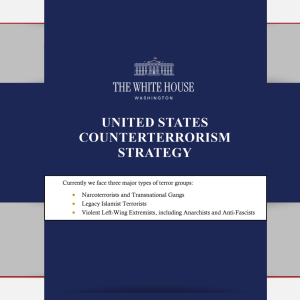
The federal government has been naming anarchists as threats since the Anarchist Exclusion Act of 1903, which barred anarchists from entering the United States and authorized their deportation. That was the first time the government put the target category in writing. It would not be the last.
From 1956 to 1971, the FBI ran COINTELPRO (Counter-Intelligence Program). Its formal mandate was to “expose, disrupt, misdirect, discredit, or otherwise neutralize” organizations the Bureau considered subversive.
COINTELPRO targeted the Communist Party, the Socialist Workers Party, the Puerto Rican independence movement, the American Indian Movement, the Black Panther Party, the Southern Christian Leadership Conference, the Congress of Racial Equality, and Martin Luther King Jr. personally. The FBI designated King “the most dangerous Negro in America” in 1964. He received the Nobel Peace Prize that same year.
Neutralization was a technical term. It did not mean arrest. It meant the organized disruption of a group’s capacity to function, by whatever means were available, whether or not individual members were ever charged. Anonymous letters were sent to members’ families, employers, and allies to destroy reputations. Forged correspondence between organizations to manufacture distrust and internal conflict. Paid informants inside organizations, gathering information and, in some cases, inciting illegal activity that could then be prosecuted. Raids coordinated with local police. In the most documented cases, direct coordination with local law enforcement in the murder of movement leaders. Fred Hampton and Mark Clark were killed in a pre-dawn FBI-coordinated raid in Chicago on December 4, 1969. Hampton was 21. Clark was 22.
Most of the people targeted by COINTELPRO were never charged with anything. They lost jobs, housing, relationships, and organizing capacity. The program fragmented the Black Panther Party, tore apart the Civil Rights Movement, and disrupted the possibility of a sustained radical left in the United States for a generation. It did most of that without a single prosecution.
COINTELPRO was exposed in 1971 when activists broke into an FBI field office in Media, Pennsylvania, and took classified documents. Congressional investigation followed. The Church Committee documented the full scope. The FBI was ordered to officially end the program.
Despite the end of COINTELPRO, the legal framework for targeting activists expanded. The Patriot Act, passed in 2001, gave the government broad authority to surveil Americans with limited judicial oversight. The FISA courts, formalized through the Foreign Intelligence Surveillance Act in 1978 and significantly expanded after 2001, allowed intelligence agencies to monitor communications in secret. Informant programs seeded organizing spaces with paid government agents. The material support statutes, strengthened through the Antiterrorism and Effective Death Penalty Act in 1996 and expanded again after 9/11, made it a federal crime to provide assistance—however loosely defined—to anyone the government designated as a terrorist. These tools were built across administrations of both parties.
The 2026 strategy updates the list and gives it national security authority. Understanding who gets on that list requires looking at who has always been left off it.
The Ku Klux Klan has conducted organized political terror against Black communities for 160 years. A federal grand jury declared the Klan a terrorist organization in 1870. The FBI has investigated Klan violence since 1918. Over a million people signed petitions in 2020 demanding a federal terrorist designation.
There is no federal domestic terrorism statute. No domestic group can be formally designated under the legal frameworks used for foreign organizations. This gap has persisted through administrations of both parties. The current administration did not propose closing it. It instead used executive authority to designate antifa, the shorthand for anti-fascist organizing, leaving the Klan’s status exactly as it was.
In 2020, Trump promised to designate the KKK as a terrorist organization alongside antifa. He followed through on one of those promises.
The Klan’s violence has served the interests of landowners, political machines, and labor suppression for a century and a half. It has reinforced state power in most of the regions where it operates. Antifascism works differently. So does mutual aid, tenant organizing, and deportation resistance. Organizing that builds collective capacity outside state authority poses a political threat, regardless of the label under which it operates.
PBS NewsHour reported that the strategy omits right-wing extremism entirely. Over the past decade, right-wing extremists have carried out 152 attacks in the United States and killed 112 people. Left-wing extremists carried out 35 attacks and killed 13. These numbers come from the government’s own research. The 2026 Counterterrorism Strategy ignores them.
The Biden administration designated white supremacy as the most dangerous domestic terrorist threat in 2023. The Counterterrorism Strategy quietly reverses that without saying so.
The administration has spent the last 16 months actively protecting organized right-wing violence. On January 20, 2025, Trump pardoned more than 1,500 people convicted or charged in connection with the January 6 attack, including Proud Boys leaders Tarrio, Biggs, Nordean, Pezzola, and Rehl. In April 2026, the DOJ moved to vacate the seditious conspiracy convictions of Oath Keepers founder Stewart Rhodes and the remaining Proud Boys leaders convicted for planning and executing the assault on the Capitol. In 2021, Canada designated the Proud Boys a terrorist organization. New Zealand followed. The United States has not.
The document’s operational language, the section that allocates resources and directs investigators, identifies “rapid identification and neutralization of violent secular political groups whose ideology is anti-American, radically pro-transgender, and anarchist.”
The document reaches for a specific justification. It cites “the assassination of Charlie Kirk by a radical who espoused extreme transgender ideologies.” Kirk was shot and killed at Utah Valley University in September 2025. The accused shooter had a transgender partner. Investigators and journalists who covered the case noted the connection was speculative. The administration built it into the strategic framework anyway.
Opposing the administration’s policies on gender is now part of the definition of what makes a group a national security priority. The document does not say “antifascist.” It says “radically pro-transgender, and anarchist.” Anyone organizing against deportations, against detention, or against the criminalization of trans people is included in that language. The document does not need to name you specifically. It was written so it doesn’t have to.
Building the Precedent: Prairieland
A strategy document that names new targets needs legal infrastructure to back it up. In the months before the administration released the 2026 United States Counterterrorism Strategy, the DOJ was building that infrastructure through a single case.
When the administration designated antifa as a domestic terrorist organization in September 2025, the designation had no direct legal force. There is no federal domestic terrorism statute, so it carries no formal enforcement mechanism on its own. What it did was signal to federal prosecutors which cases to prioritize and how to frame them. The Prairieland prosecution was the test of whether that framing would hold up in court.
On July 4, 2025, a group of protesters gathered outside the Prairieland Detention Center in Alvarado, Texas, an ICE detention facility. They planned a noise demonstration. Defense attorney Xavier de Janon described it: “What people do outside is just literally noise. The purpose is to get people inside to remember that they’re not forgotten.” They brought fireworks, spray paint, and a megaphone.
Benjamin Song, a former Marine Corps reservist in the group, also brought an AR-15-style rifle. When police arrived, Song opened fire and shot an officer in the neck. Song was convicted of attempted murder and faces a minimum of 20 years.
The prosecution’s primary interest was the eight other people present. None of them fired a weapon. None of them had planned the shooting. Several had no idea it was coming. The government’s theory was that they were all liable anyway.
The material support statute was the vehicle. Under that statute, prosecutors need not prove terrorist intent. They only need to show that a defendant assisted someone who committed a federal crime. Song’s shooting was a federal crime. Everyone present at the protest was potentially liable for having been there.
All eight were convicted in March 2026 of providing material support to terrorists. What the prosecution used to establish that material support: wearing black clothing at the protest, using the Signal messaging app, and carrying anarchist literature. The prosecution’s antifa expert, Kyle Shideler, is director of the Center for Security Policy, a Washington think tank the Southern Poverty Law Center has designated an anti-Muslim hate group. He helped write the definition of antifa used in the indictment. Under cross-examination, he acknowledged that nowhere in the Signal chats did anyone mention antifa, discuss harming people, or plan property damage, and that everything the defendants did was consistent with a noise demonstration up until the rifle fire. Sentencing is scheduled for June 18, 2026. Seven of the eight face between 10 and 60 years each. One faces up to 40 years.
Former DOJ counsel Tom Brzozowski described what was actually being built: “They’re trying to kind of concentrate all that and distill it into this working definition of antifa and get that next to a terrorism-related charge” to signal enforcement intent. The antifa label barely appeared in the actual trial. It came up once across dozens of pages of jury instructions. Judge Mark Pittman questioned the prosecution directly: “Whether it’s antifa or the Methodist Women’s Auxiliary of Weatherford, why does it matter?” The government said it was prosecuting conduct. Washington sent top DOJ officials to headline the press releases anyway.
The convictions came in March 2026. The 2026 United States Counterterrorism Strategy was released two months later. The strategy now directs every relevant federal agency toward the target category this verdict established. Showing up to a protest where someone else commits violence, communicating over Signal, wearing black, carrying political literature: these are prosecutable as terrorism support, confirmed by a federal jury, available as precedent.
The Proud Boys stormed the Capitol. Pardoned. The Oath Keepers planned and executed seditious conspiracy. Convictions being vacated.
And the people outside a detention center with a megaphone? Convicted terrorists awaiting sentencing.
What Neutralization Means Now
What follows the Prairieland verdict is the surveillance of activists and silencing of dissent under the thin guise of national security. As Brzozowski explained, Trump’s 2025 executive order directed agencies to investigate “all participants in these criminal and terroristic conspiracies.” That investigation runs outside the public view. “That’s probably ongoing as we speak,” he said. “None of that is going to show up as a high-profile federal criminal case.”
Agencies that previously needed justification to surveil an activist group now have a national strategic document naming their targets as priority threats. This is a resource allocation document. It tells federal investigators where to focus and what legal framework supports the attention.
Signal encryption protects message content. Metadata showing who is communicating with whom is accessible through legal process. Political literature in your bag is on record as terrorism evidence. At a demonstration where one participant crosses a legal line, everyone else who was present, who communicated with participants beforehand, or who provided food, medical supplies, or legal support is within reach of the material support charge.
The investigation itself is the disruption. Knowing a federal informant may be present changes how people communicate and who they trust. That was the intended effect in 1969. It is the intended effect now.
The 2026 United States Counterterrorism Strategy says operations will be “apolitical” and will not target Americans who “simply disagree.” There is no enforcement mechanism attached to that promise. There is no legal definition of what separates “simply disagreeing” from being a violent secular extremist who is radically pro-transgender and anarchist. That line gets drawn by investigators and prosecutors working under a document that tells them antifascists, trans organizers, and anarchists are a priority national security threat.
The state does not target organizing because it is violent. It targets organizing because of the threat it poses to entrenched authority. The 2026 strategy is that logic made into official policy, but the logic predates the document by over a century.
The state deploys security language against political threats because security language ends debate. You cannot negotiate with terrorism. Calling antifascists and trans organizers terrorists removes them from the political conversation entirely. The 2026 strategy does not need to prove these groups are more dangerous than armed white supremacist networks. It needs the designation in place. The danger being managed is political, not physical.
The 2026 United States Counterterrorism Strategy did not arrive in isolation. Read alongside Project 2025 and its 2026 rebranding as the Golden Age agenda, the Big Beautiful Bill, and the Supreme Court’s April 2026 decision in Louisiana v. Callais, which gutted Section 2 of the Voting Rights Act, a coordinated direction becomes visible. These are not separate policy decisions. They form a coordinated effort to concentrate power, eliminate opposition, and remove the legal mechanisms that would allow communities to fight back. This is what the rise of fascism looks like in the United States.
Tracking the Rise of Fascism in the U.S.
ARG has been tracking this build since before it had a name. The pattern became visible in stages, and each stage confirmed what the previous one suggested.
In November 2024, our Silencing Dissent podcast episode covered the shared authoritarian playbook: surveillance, infiltration, and reputational destruction. We traced it from COINTELPRO through the post-9/11 legal architecture, including the Holder v. Humanitarian Law Project precedent that made association with a designated group prosecutable even absent violence. We said those techniques were active. What we were watching, without yet having the document to prove it, was the construction of a legal and institutional framework designed to contain organized opposition.
The June 2025 analysis of how political labels get weaponized showed the next layer. Collapsing every form of opposition into a single imagined threat is how that framework justifies itself publicly. The right, the center, and liberal institutions all participate in this collapse, each for its own reasons. The 2026 United States Counterterrorism Strategy is a national security document with federal enforcement authority behind it.
The December 2024 deportation resistance work covered the ground-level reality: what community organizing against ICE enforcement looks like, what it costs, and what it builds. Prairieland is the state’s direct answer to that organizing. Communities build infrastructure. The state names it a terrorism support network and prosecutes the people who showed up.
From the beginning of the Resist Project 2025 work, we named LGBTQ+ targeting specifically: gender-affirming care restrictions, anti-discrimination rollbacks, and the systematic removal of trans people from public life. The “radically pro-transgender” terrorism designation in the 2026 strategy is the escalation of what was already in motion, now formalized as a national security priority.
The Big Beautiful Bill funds the enforcement infrastructure. The 2026 United States Counterterrorism Strategy names who gets targeted with it. These are not separate efforts. They are the same project at different stages. None of this arrived without warning. Treating it as a sudden shift lets too much off the hook.
What to Do
The state has always moved against organizing that threatens its control. This is not a recent development, nor is it unique to the United States. It predates the FBI, predates the United States itself, predates every specific law and designation discussed in this piece. What changes is the legal language. The target has been consistent. COINTELPRO did not end organized resistance. It disrupted it, fragmented it, murdered some of its leaders, and set movements back by a generation. The work continued anyway. The Anarchist Exclusion Act of 1903 did not end anarchist organizing. The post-9/11 domestic terrorism designations did not end environmental defense or animal rights organizing. The organizing has outlasted every version of this playbook—not because it was unstoppable, but because the need for it never went away.
That need is not going away now.
Security culture is not an overreaction to the current moment. It is the appropriate response to a legal precedent that now makes encrypted messaging, black clothing, and political literature prosecutable as terrorism evidence. How you communicate, how you document your work, and who knows what about planning decisions carry real legal weight. The investigation itself is a disruption tactic. Knowing that shapes how you organize. Groups that have thought carefully about these questions are worth finding and learning from.
The longer answer to “what should we do now?” lives in what the state is actually trying to prevent. Mutual aid is not charity. It is not an emergency response or a stopgap while waiting for a better policy. It is communities meeting their own needs outside systems that profit from their desperation. Food networks that feed people because the community decided everyone eats, not because anyone qualifies. Housing support that keeps families in their homes because neighbors built the means to make that happen. Medical care is organized through relationships of trust rather than through systems that extract profit at every step. Legal support, childcare, money, information—all of it flowing through networks of mutual care that exist because people built them.
When communities build enough of this, something shifts. The systems that extract compliance by controlling access to basic needs lose their grip. Eviction becomes harder to enforce when the entire building organizes. Deportation becomes harder to execute when the whole neighborhood knows to warn each other. The state’s ability to isolate and punish individuals weakens when those individuals are held inside dense webs of community relationships. That is what the 2026 strategy is trying to prevent. Not the violence, but the interdependence.
This is why the designation of mutual aid as terrorism is not evidence that it is dangerous. It is evidence that it is working. They can name it terrorism. They cannot stop neighbors from feeding each other. They can seed organizing spaces with informants. They cannot unwire the relationships communities have already built. They can prosecute individuals. They cannot prosecute the practice of collective care that has kept communities alive for as long as communities have existed. More of that work, built more carefully with deeper roots, is the response to this moment.
The ARG Mutual Aid General Fund moves money directly to community-led projects with no overhead and no strings attached. Every dollar goes to the groups doing the work. Farmworker Rental Assistance keeps families housed when the systems designed to displace them bear down hardest. Financial solidarity with groups like General Strike U.S. builds the organizational infrastructure that makes sustained resistance possible.
The question this moment asks is not whether to keep building. Communities will keep building because they always have. The question is whether we recognize what we are building for, whether we resource it seriously, and whether we build it with enough depth and connection to withstand what is being organized against it.
Fascism depends on communities forgetting what they are capable of together. Every designation, prosecution, and surveillance program discussed in this piece was designed to make that forgetting happen. None of them succeeded completely. The work continued because the need for it never left. That is still true now.