


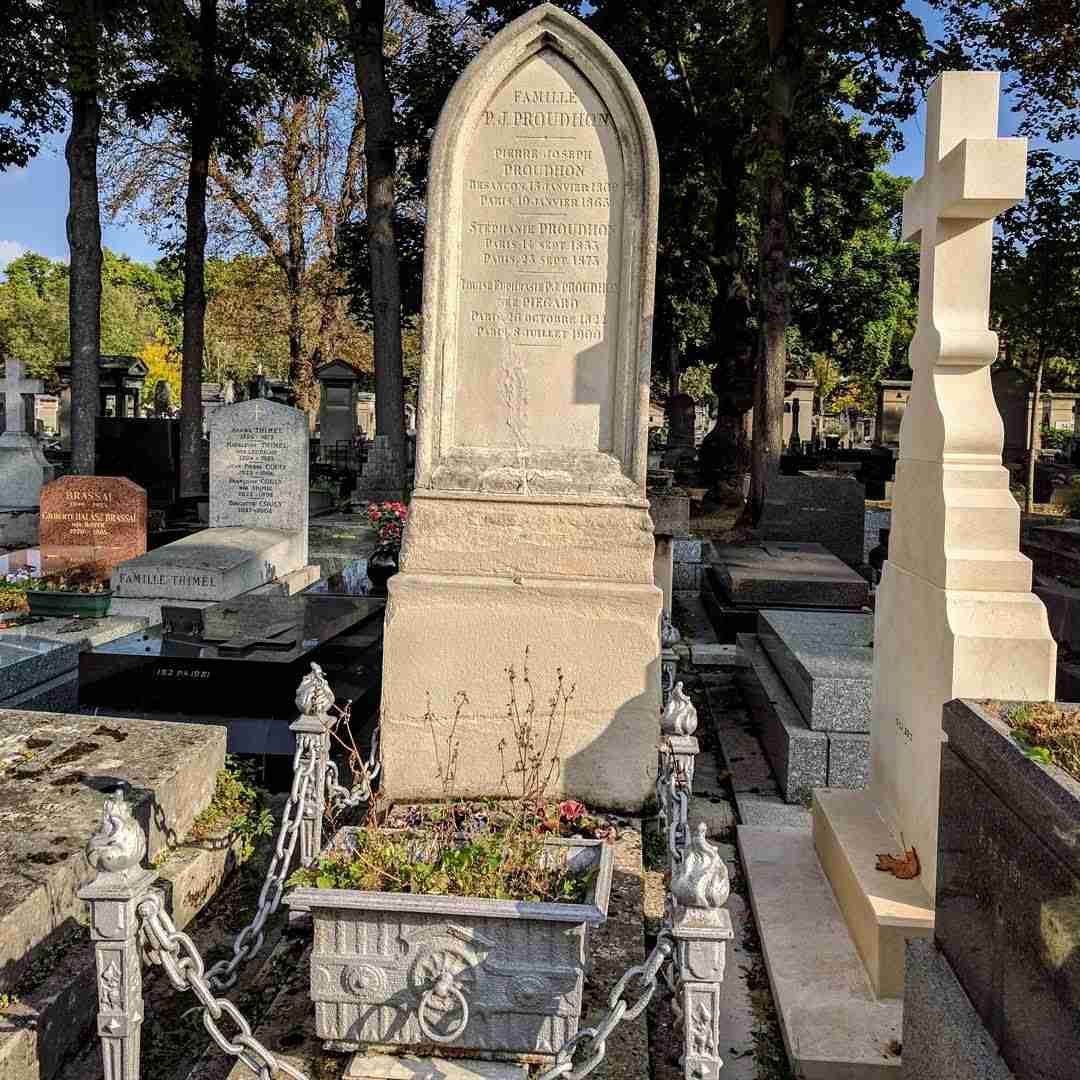

Grave of Pierre-Joseph Proudhon
Pierre-Joseph Proudhon was born in 1809 in Besançon, the son of a cooper and tavern keeper, and grew up poor. He taught himself Latin to better practice his trade as a printer, and somewhere in the process of studying books, he became the person who would write them. In 1840, he published What Is Property?, in which he answered his own question with the phrase “property is theft” and declared himself, for the first time in print, an anarchist. He was the first person to use the word that way about himself, and the ideas he developed around it — mutualism, federalism, workers’ credit, the abolition of wage labor — shaped every major tendency of anarchism that followed.
Proudhon’s thought was a direct challenge to both capitalism and state socialism. He opposed centralized authority, whether it came from a monarch, a parliament, or a revolutionary vanguard. His public argument with Karl Marx in the 1840s — conducted through books, letters, and mutual contempt — crystallized the split between anarchist and Marxist politics that would play out in the First International two decades later, and in movements ever since. Bakunin carried much of Proudhon’s framework into the International, and the federalist and syndicalist traditions of Spain, France, and Latin America drew heavily from his writing. His work also reached individualist anarchism in the United States through Benjamin Tucker, who translated and published him.
His legacy is contested. Proudhon held antisemitic and misogynistic views that appear explicitly in his published writing, and these are not peripheral to understanding him. Several generations of anarchist and socialist thinkers have grappled with how to hold their foundational contributions alongside those documented positions. He is a figure whose ideas traveled far and were transformed in the using.
Proudhon died in Passy on 19 January 1865 and was buried in Paris at Montparnasse Cemetery.
 Own or work here?
 Other Locations Near Here


More from A Radical Guide

