


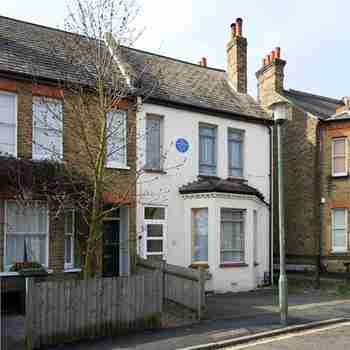


Peter Kropotkin Blue Plaque
Peter Kropotkin moved to Bromley in the summer of 1894, renting a semi-detached Victorian house on Crescent Road in what was then a quiet commuter suburb south of London. He and his wife Sophie named it Viola Cottage. He had arrived in London after imprisonment in Russia and France for his political organizing, and the relative freedoms of English exile gave him space to write. The English Heritage blue plaque on the exterior of the house, erected in 1989, marks this as the site where Kropotkin produced the bulk of his most consequential work.
The years at Crescent Road were Kropotkin’s most intellectually productive. He completed The Conquest of Bread (1892), Fields, Factories, and Workshops (1899), and Mutual Aid: A Factor of Evolution (1902) during his London years, with much of that writing done at this address. Mutual Aid in particular grew directly from his decades of work as a naturalist, drawing on field observations from Siberia to argue that cooperation, not competition, is the engine of evolutionary survival. The book became one of the foundational texts of anarcho-communism and remains a living reference for mutual aid organizing today.
Viola Cottage also functioned as a gathering point for the international anarchist movement of the period. Visitors included Emma Goldman, Louise Michel, Rudolph Rocker, Harry Kelly, and Fernando Tarrida del Mármol. Kropotkin corresponded with and was visited by figures from across the labor and anarchist movements of Europe and North America. When news of the Bloody Sunday massacre reached London in January 1905, reporters camped outside the house seeking comment. He was ill and simply sent out a handwritten note. The house sat mid-way between Sundridge Park and Bromley North train stations, an ordinary suburban setting that housed an unusually concentrated period of anarchist writing and internationalist connections.
Kropotkin left Bromley around 1907, eventually relocating to Muswell Hill and later to Brighton, before returning to Russia after the February Revolution of 1917. He died in 1921 near Moscow. His funeral drew tens of thousands and was the last major anarchist demonstration permitted before the Bolshevik suppression of the movement. The plaque at 6 Crescent Road is administered by the London Borough of Bromley under the English Heritage blue plaque scheme and is accessible on the public street.
Also see: Statue of Peter Kropotkin
 Own or work here? Claim Now! Claim Now!
Other Locations Near Here


More from A Radical Guide

